
There’s a common belief that many people make in relationships without even noticing it that love, on its own, will be enough to establish an ongoing relationship. It may sound appealing but it isn’t always able to hold up in reality. The relationships that are likely to last, which feel solid instead of exhausting, were usually created with two individuals who know their own needs first. Understanding your preferences, your routines as well as your non-negotiables and the way you navigate across the globe gives you something you can bring to the relationship, not finding something within it. This is the base of a successful relationship and it starts before you meet another person.
Self-awareness isn’t a fashionable buzzword that is borrowed from the self-help culture. It’s a real-world technique that influences the way you communicate and handle conflicts, and also the way you select your partner to begin with. If a person is in a relationship with no clearly defined identity, they tend to become a mold for the other person, instead of creating something that is their own. In time, this can lead to tension, anger and an unspoken exhaustion that no one is able to identify. A relationship that is based on two distinct individuals, both confident in their own identity is likely to appear and feel completely different. The relationship has room to breathe. It can handle conflict without falling apart. Over time, it grows instead of merely continuing.
Why Individual Identity Comes Before Partnership
Many people believe that relationships should bring two people together like two halves forming a whole. However, healthy relationships thrive when two individuals choose to share each other’s journey rather than rely on one another to fill a gap within themselves. If someone believes that their partner will give them the motivation or stability they’ve never found within themselves, the bond quickly gets a bit stale. A partner, no matter how wonderful, will never be able to bear the burden of being someone who is someone else’s whole base.
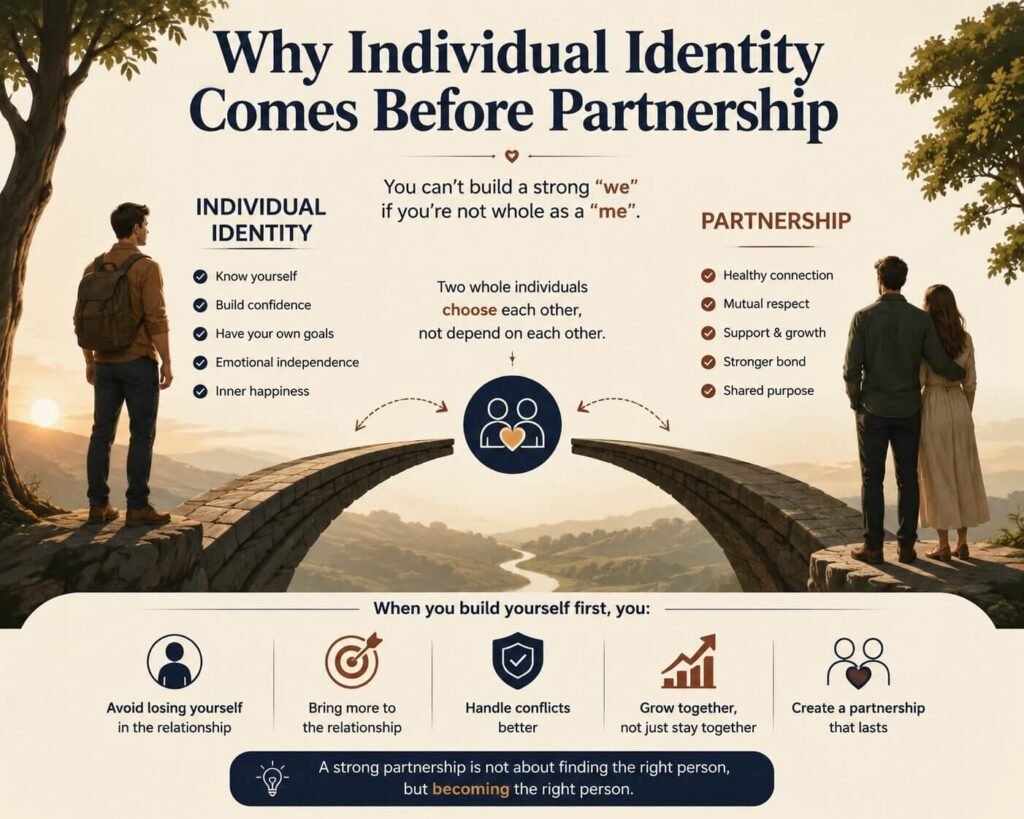
This is why the process of getting to know yourself, your beliefs and emotional patterns along with your individual boundaries is necessary to be completed without regard to the seeking of an ideal partner. It’s not about becoming fully self-sufficient and emotionally secure before you are able to have a relationship with somebody. It’s about being able to define who you really are so that you are able to enter the relationship as a contributor instead of someone who wants to be saved or finished. The people who have completed this inner work are able to be more direct in their communication, establish boundaries with more ease and are able to recover faster from conflicts simply because their identity isn’t entirely dependent on the dynamics of their relationship.
Why Autonomy Strengthens Healthy Relationships
In a relationship, autonomy is not a sign of distance or independence solely for itself. This means that each person has their individual interests, friendships, opinions, and personal identity while forming a shared identity. Two individuals who are independent tend to form a relationship that is more stable than two individuals who have joined so seamlessly that neither of them can tell where they finish and the other is beginning. The kind of fusion that is possible could be intense in the initial stages, but it typically gets suffocating as time goes on and leaves room for individual development or open disagreement.
The Role of Self-Knowledge in Choosing a Partner
Understanding yourself isn’t just an exercise in personal growth. It’s a practical filter that allows you to recognize the signs of compatibility and, equally important, can help you determine what is not an appropriate fit. If you do not have a clear understanding of your personal preferences and values it can be difficult to assess the prospective partner independently. You may be drawn to a person solely because of the attraction or comfort, without examining the way they approach life, conflict, or connections that actually match your preferences.
This is the point at which how you get to know a person becomes more than just a matter of surface compatibility, but more about watching patterns develop over time. Attraction can occur quickly however genuine compatibility shows it gradually through frequent interactions, small instances of tension, and manner in which people handle situations that don’t follow the plan. Being aware of these patterns in the beginning instead of being caught by the excitement of meeting a new friend provides you with more reliable information regarding whether the relationship is built on a base to endure.
How Someone Solves Problems Tells You More Than Words Ever Will
A single of the most interesting things you can learn about potential partners is not the things they say about their character, but the way they deal with problems when they occur. The language is simple. Anyone can say they are calm, patient or a great communicator. The way they behave under pressure can tell a different story. How someone responds to an argument, a stressful situation, or unexpected setback can provide insight into their emotional state and their ability to accept responsibility, and their general approach to problems and challenges. All of these will determine the overall health of the relationship in the future.

Certain people tend to withdraw when they encounter problems, and go silent or physically distancing from the situation instead of engaging in a direct confrontation. Others are more inclined to the opposite reacting defensively or reactively whenever tension arises. The two patterns are not inherently unfavorable in itself however knowing which direction an individual has and how aware they are of it, is vitally important. Anyone who acknowledges their self-deflection and actively seeks to talk instead, is demonstrating an entirely different degree of emotional maturity from one who is withdrawn and expects their spouse to just be silent and not give a reason.
How Conflict Reveals Relationship Readiness
The way they solve problems also shows how a person views partnerships. Do they view the issue as one that needs to be solved in a team, and treat each person as part of the same team, working towards an agreed-upon resolution? Do they view conflicts as a game or something that can go to the winner or losers where the pursuit of being right is more important than achieving a mutual agreement? This is the basis of the majority of future disputes the couple may have in their lives, from minor logistical issues to big life decisions. Someone who is able to disagree with you but still regard you as a friend instead of an adversary is showing one of the most evident indications of readiness for a relationship.
Conflict Resolution Reveals Emotional Maturity
It is also important to pay attention to the way someone handles the consequences of their mistakes. Are they willing to take responsibility for a mistake and then shift the blame elsewhere? The ability to be accountable is an essential characteristic in any relationship that lasts for a long time, since all relationships will include instances where one or both partners do not meet the best intention. One who is able to acknowledge an error without displaying excessive defensiveness and apologize in a sincere manner, as well as modify their behavior to improve shows a potential to grow that will benefit the relationship well for a long time.
Understanding Love Languages as a Tool, Not a Formula
It is believed that the concept of loving language is widely accepted as a way of understanding how people like to share and receive affection. Generally, they are being classified into categories such as words of affirmation or quality time, gestures that show service, touches and receiving kind gestures. Although this isn’t an academic formula however, it’s a beneficial starting point for understanding the ways you and your potential partner communicate affection and also, more importantly the way you both interpret your partner’s care.
The mismatch of love languages is an often-repeated source of friction in relationships. This is not because the person in question is doing something wrong, but rather because their preferred method of expression affection doesn’t always translate to the way their partner accepts it. A person who expresses love mostly through service activities like by regularly aiding in tasks or duties could be uncomfortable or even hurt when their partner doesn’t think of the gesture as a sign of affection, particularly in the case of a partner who is more accustomed to the power of words or spending time together. There is no wrong or right in this situation. Both are speaking their own emotional languages, and they are not aware of it.
Why Love Languages Improve Communication
Knowing your partner’s love language from the beginning and being truthful about your own, enables both of you to make small, but significant changes that dramatically enhance the way that everyone feels. This doesn’t mean putting yourself to adopt a non-natural method to express affection forever however, rather being aware enough to periodically change your normal behavior to be able to understand your partner exactly where they are. A relationship in which both parties are able to understand and meet their emotional needs this way is much more secure than one which is characterized by constant affection but does not always come out exactly how it was meant to.
Shared Values as the Real Foundation of Long-Term Compatibility
Attraction, attraction, the chemistry of a relationship, and the shared interests are all important in relationships, but they’re rarely the determining factor in how long a relationship will last through the tough times of life. Values are the primary factor because they determine the way each person makes important life decisions, deal with the challenges that come their way, and determine what a fulfilling life appears to be. Two people could have completely divergent interests, personalities, and even styles of communication, yet still form a solid relationship provided that their fundamental values align with the things which matter to them as individuals.
They can be a reflection of how people perceive the importance of honesty, transparency and their approach to financial decisions, the importance family has in their lives as well as how they approach their personal development, and what they think is a fair share of responsibility and effort in a partnership. These aren’t always subjects that are discussed during initial conversations. This is why actively investigating them, rather than presuming compatibility based on superficial chemistry, is important in getting to know your potential partner.
Exploring Values Before Making a Commitment
The beliefs of a person, whether they are philosophical, religious or just personal beliefs regarding the way life should be conducted, can play a crucial role in this. It is possible that two people have differing views while accepting and embracing the other’s viewpoint, however it can be a challenge when those beliefs conflict with what each person regards as important to their existence or everyday life. Being aware of the position you are in with these more fundamental questions prior to beginning a relationship that is serious lets you have open, relaxed conversations about them with your potential partner, and not be surprised by the fact that there is a fundamental gap in the relationship when a substantial emotional commitment has already been placed.
The Influence of Norms and Expectations
Beyond personal values, every person develops a set of expectations, often shaped by their environment, cultural background, and past relationships, that influences what they seek in a partnership. These expectations may include how couples handle conflict, the level of independence each partner maintains, how they divide responsibilities, and even the amount of personal space each person needs on a regular basis. Because people often view these expectations as common sense, they rarely discuss them until a situation reveals how differently two partners see the same relationship.
To get to know a person effectively requires taking note of these implicit expectations, not only those that are obvious, such as values and beliefs. A person who was raised in a setting that was tolerant of confrontation and healthy may respond to disagreements in a different way than one who was raised in an environment that was averse to conflict. There is no absolute right or wrong way to approach it However, a significant difference when not addressed, could cause an ongoing conflict that neither is able to fully comprehend the root of. Engaging in honest discussions about these expectations early and being open instead of judging the source of these norms aids both sides to overcome differences with compassion instead of anger.
Building a Relationship That Honors Both People
A relationship that is based on self-awareness and mutual understanding is likely to be distinct from one that is primarily based on convenience or attraction. It requires a constant interest in your partner, instead of making assumptions and a willingness to engage in candid discussions about expectations and values even when they’re uneasy, as well as a determination to preserve your individuality regardless of the project you are building together. This type of relationship will not completely eliminate conflict, as conflict is an element of any close relationship however, it alters the way conflicts are handled, changing it from something that is threatening to something that actually improves friendship in the course of time.
It also means that you recognize that an effective relationship cannot be defined in terms of the lack of issues and how well two people work together. This is the reason observing how they solve problems early on holds significant significance. Anyone who tackles problems with honesty, respect and a sincere desire to know your viewpoint is showing exactly the type of behavior that is important the most during the difficult moments that any long-term relationship encounters.
Practical Ways to Get to Know a Partner More Deeply
The process of establishing this type of understanding is not achieved through an individual conversation, it is a matter of constant, deliberate attention to the situation to each other over the course of time. Some practical strategies can assist in creating the type of environment in which the real connection is apparent.
- Take note of the way your partner responds to small issues, like delays on flights or a mishap at a restaurant. These moments with low stakes frequently show the similar patterns that are evident when confronted with larger issues.
- Ask questions directly about your values, financial habits, values, and long-term goals sooner than is comfortable, rather than thinking that these issues will naturally arise in their own way.
- Watch your partner’s conversations about their past relationships and conflicts. The way a person talks about their past experiences can reveal their self-awareness as well as the level of accountability.
- Be aware of how they treat people who are unable to offer anything for their services, like strangers or service workers since this can reflect real character more than the way they treat you in the initial phases of dating.
These daily, infrequent observations provide more accurate data than extravagant romantic gestures or superficial compatibility, as they show how a person lives day-to-day instead of how they present themselves in ideal situations.
Conclusion
A truly healthy relationship does not depend on the basis of finding someone who complements you, but rather on two individuals who have made the effort to understand their own motivations to create something that is meaningful. The self-awareness that comes from independence allows for relationships to evolve without becoming dependent, to manage conflicts without breaking up and to be open even when being honest isn’t comfortable.
Being attentive to how potential partners solve issues, understanding your personal and their love language as well as exploring common beliefs and values, and being curious about the values and norms that each brings to the relationship can be effective tools for establishing lasting relationships. These kinds of relationships are less of an effort to find a way out and more like a real relationship between two individuals that is the reason they are likely to last well beyond the excitement of the beginning phases.