
Introduction
They can influence our emotional wellbeing and impact our personal development and alter our perception of ourselves. Although healthy relationships promote mutual respect and support of each other, some relationships begin with good intentions, but then turn into emotionally draining. One of the least understood ways to avoid these negative dynamics is commonly referred to by the name of Broken Wing Syndrome.
The expression refers to a scenario in which a person is drawn to those who appear to be emotionally wounded believing that patience, love, or continuous support can in the end “fix” them. At first, this kind of behavior could appear loving or compassionate. In time it may turn into co-dependency. In this case, the identity of one person and their emotional stability are entwined with the task of rescuing or managing the life of another.
The pattern may appear at any age, however it usually appears very different in accordance with your life stage. Teenagers who are experiencing their first love are faced with different emotional issues when he or she begins an unplanned relationship following divorce or years of adult responsibility. Understanding these differences is vital for developing relationships that are built on trust and not just emotional rescue.
This guide explains Broken Wing Syndrome, how it relates to co-dependency and how to develop more healthy, stronger relationships at various stages of life.
What Is Broken Wing Syndrome?
Broken Wing Syndrome is not an official psychological or medical diagnosis however it is a common term to describe a regular relationship pattern. It describes the intense desire to save and heal or restore someone who appears to be extremely hurt or inaccessible emotionally.
The people who are caught in this type of pattern tend to believe that their love will alter the behavior of another or ease emotional hurt that has been lingering for a long time. They might feel that they are responsible for their spouse’s happiness and keep placing their needs over their own.
At first, these acts might appear to be generous. Helping your partner through difficult times is an essential element of a healthy partnership. The difference lies in determination and balance. A healthy relationship allows others to develop while Broken Wing Syndrome often creates dependence, in which one person becomes the rescuer, while another is receiving the rescue.
The imbalance could slowly take over the role of equality and emotional accountability, leaving both in a state of confusion and frustration.
How Broken Wing Syndrome Can Lead to Co-Dependency
The person’s emotional wellbeing becomes strongly dependent on another’s actions, their approval or struggle. Instead of two distinct people deciding to live an existence with each other, the relationship starts with one person’s struggles and the other’s desire to resolve these issues.
A person suffering from Broken Wing Syndrome may gradually ignore their personal goals, friends activities, hobbies, or even mental health as they try to be supportive of their loved ones. The self-worth of their partner is based on feeling needed instead of being appreciated.
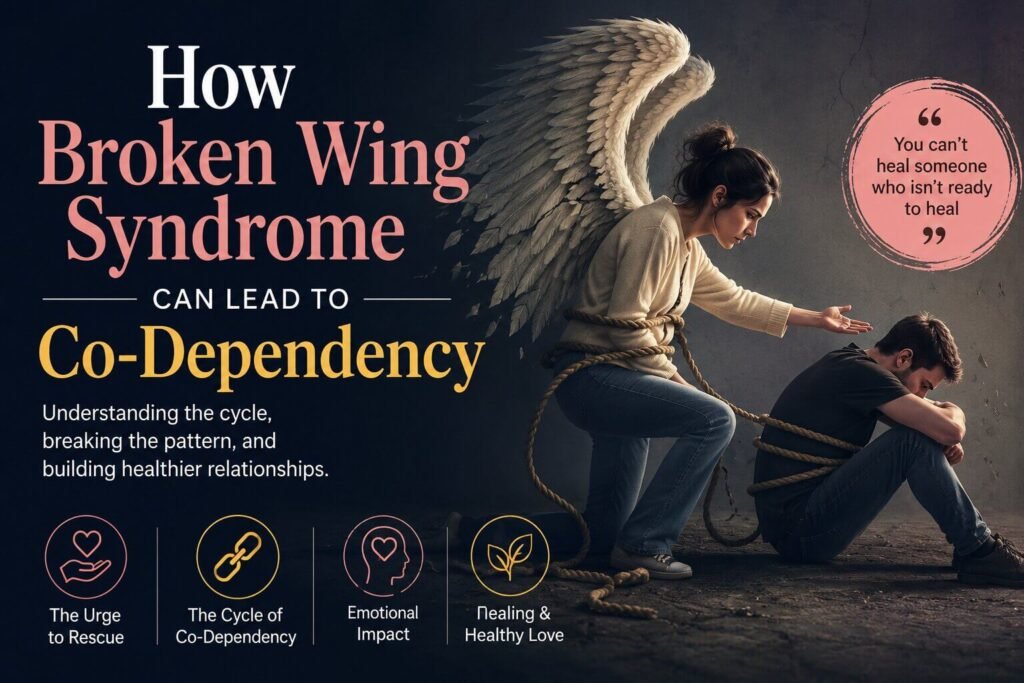
The partner who receives constant help can also become dependent on this arrangement. Instead of developing more effective ways of coping or seeking out adequate support, they could depend on their companion to handle emotional issues as well as resolve conflicts or take difficult decisions.
In the end, both individuals are trapped in a vicious cycle that is difficult to break out of.
Why People Feel the Need to Rescue Others
The desire to assist people you love is normal. However, when that helping becomes a threat to your own mental health it’s important to consider the root causes of that pattern.
For some people the desire to help others stems from childhood experiences. Growing up in a place in which love was associated with caring for others can make adult relationships seem familiar only when they require the emotional burden of caring for others.
Some people believe that they need to be loved by constantly thinking that they’re only worth their weight when they solve another’s problems.
Fear can also play a role. Fear of being abandoned or loneliness could cause people to avoid bad habits because they fear that their relationship could end when they stop helping their partner.
Recognizing these motives is an essential step in making better relationships.
The Difference Between Supporting and Saving
One of the most common mistakes in relationships is the misinterpretation of support with accountability.
Being supportive of someone is encouraging them to be independent while respecting their individuality. It is about listening, giving advice when needed and standing by them in difficult moments.
Saving someone is a different thing. It is a matter of taking responsibility for issues that only they are able to overcome.
Healthy relationships acknowledge that personal development cannot be forced on someone else. Change that lasts is when people decide for themselves their own healing, choices and actions.
A supportive partner walks beside you. A rescuer bears the full emotional burden of a relationship.
There are no two relationships that are born under the same conditions. Life experience, age, the responsibilities of family members, as well as personal experiences all affect the way people view relationships and love. Understanding these distinctions helps clarify why the challenges faced by couples often alter as time passes.
Why Relationships Feel Different in the Teenage Years
Teenagers’ relationships are usually full of extreme emotions, excitement and exploration. A lot of teens are experiencing romance at first and still developing their sense of self-identity and emotional stability.
Since emotional experiences are like a new experience, dramatic situations could easily be misinterpreted as profound affection.
Teenagers might believe that a person’s willingness to stand by them through continuous emotional turmoil is proof of loyalty or dedication. Television, movies and social media can promote the notion that love is not giving up on someone regardless of how sour the relationship gets.
In the absence of prior experience in a relationship it can be hard to spot warning indications. Someone who continually needs rescue may seem vulnerable rather than emotionally unresponsive.
At this point in life, boundaries for personal relationships are still being established. Teenagers are naturally blending emotions, friendships, and personal identities into romantic relationships, which makes it easy to get lost in someone else’s struggles.
Though these experiences can be difficult, they usually serve as experiences that can help to build healthier relationships later in life.
Relationships Through Every Stage of Adult Life
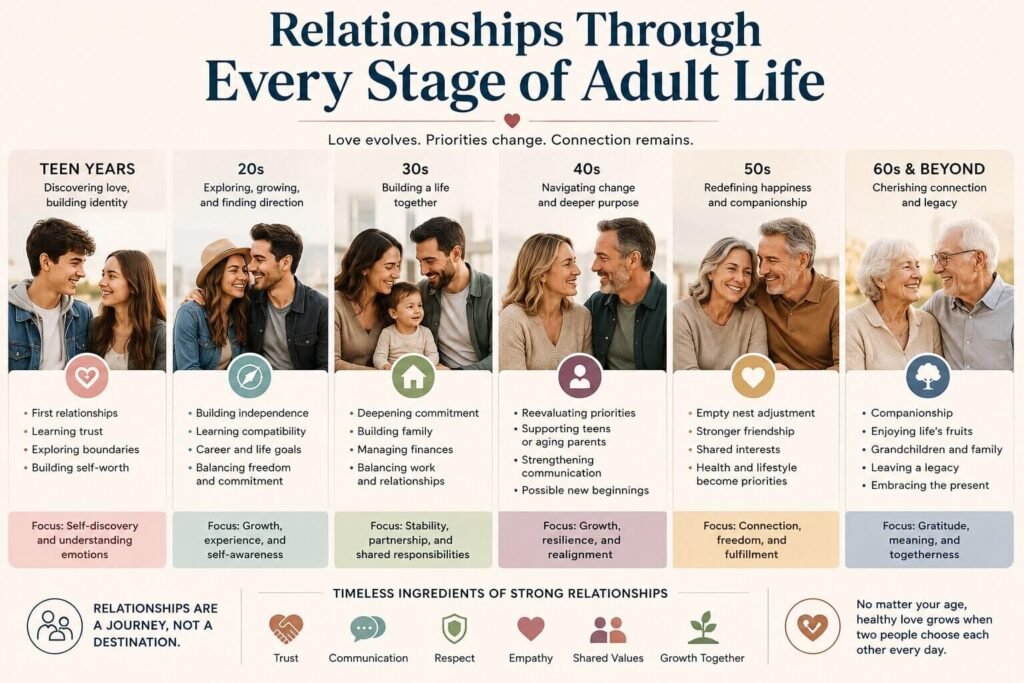
Relationships in Your 20s: Discovering Yourself While Building Connections
When you’re in your 20s, the relationships are typically formed by your own personal growth. A lot of people are finishing their education, beginning career paths, or are learning to find a balance between independence and commitment. It is normal to look into various relationships while establishing personal values and goals for the future. At this time communicating abilities as well as healthy boundaries developing, which may cause confusion or unreasonable expectations.
Relationships in Your 30s: Balancing Commitment and Responsibility
In the 30s, priorities are often more clearly defined. Many people are contemplating the possibility of marriage, having a child or buying a house, or making progress in their career. The relationship may be more deliberate due to partners seeking a relationship that will provide longevity. Balancing financial demands and family obligations is also a crucial aspect of sustaining a healthy relationship.
Relationships in Your 40s: Emotional Growth and New Beginnings
In the late 40s, individuals typically bring more emotional awareness in new relationships. Past experiences, no matter how positive or not, can offer valuable insights into trust communication, trust, and personal boundaries. However, responsibilities like raising children, caring for elderly parents, or reestablishing life following divorce can impact how new relationships develop.
Relationships in Your 50s: Prioritizing Peace and Companionship
Being in a relationship during your 50s is often accompanied by new perspectives. A majority of people place greater importance on their emotional wellbeing, companionship and common interests, rather than the fulfillment of social expectations. Many are trying to adjust to the loss of a nest or recovering from separation or loss of a partner. In this phase emotional maturity is often a catalyst for more open conversations about values personal to you, financial matters as well as health and the future plans.
Relationships in Your 60s and Beyond: Shared Experiences and Lasting Connection
For those older than 60 relationships are often founded on companionship as well as mutual support and a new chapter together. Grandparenthood, retirement, issues with health, and changes in lifestyles can alter the priorities of a relationship. Trust, emotional connection and shared experiences frequently take precedence over external expectations, which allows couples to form lasting and satisfying relationships.
Relationships in Your 70s and Beyond: Wisdom, Legacy, and Meaningful Companionship
By the time people reach their 70s and beyond, relationships are often guided by wisdom, acceptance, and gratitude rather than expectations or external achievements. Many individuals have experienced decades of personal growth, family milestones, career changes, and life’s successes and disappointments. These experiences often create a deeper appreciation for genuine companionship and emotional connection.
At this stage of life, relationships are less about changing one another and more about sharing meaningful moments together. Couples may be enjoying retirement, spending time with children and grandchildren, supporting each other through changing health needs, or finding purpose in community involvement and lifelong friendships. Open communication, patience, and mutual understanding become even more valuable as priorities naturally shift toward quality of life and emotional wellbeing.
Divorced or not. Never married Diverse Experiences and Different Perspectives
Experiences with relationships can vary according to the person’s personal background. One who has never married might approach the commitment process with a sense of curiosity and hope, however, they may have less experience in dealing with long-term partner challenges. On the other hand, someone who is divorced usually has valuable insights from past relationships, as well as emotional healing that might be in process. The experience of divorce is not necessarily more or less effective. It is important to know if each person has considered their experiences, cultivated good communication skills and are emotionally ready to begin a new relationship.
How the Family Life Cycle Shapes Relationships
Another factor that is important is the life-cycle of the family. Couples with no children might be experiencing different dynamics in relationships as parents with young children, families that are blended that combine households, or those taking care of elderly parents. Major life transitions–including welcoming a new baby, children leaving home, career changes, retirement, or becoming caregivers–can reshape relationship roles and expectations. Couples who can adapt to these changes by allowing flexible communication, open communication and respect for each other are usually better positioned to keep an ongoing, healthy relationship.
The Common Foundation of Healthy Relationships
In the end, though every phase of life has its own different challenges and opportunities, the characteristics that foster healthy relationships remain unchanging. The qualities of trust, emotional maturity, trust, communication that is clear and a desire to develop together will continue to be the foundation for strong relationships, regardless of age or the level of life encountered.
Comparing Relationship Challenges Across Life Stages
| Life Stage | Common Focus | Primary Relationship Challenge |
| Teen Years | Identity and first love | Emotional intensity and weak boundaries |
| 20s | Independence and career | Balancing personal growth with commitment |
| 30s | Family and stability | Managing responsibilities together |
| 40s | Emotional maturity | Healing from past experiences |
| 50s | Companionship | Prioritizing peace and shared values |
| 60s | Retirement and connection | Adapting to changing life circumstances |
| 70s+ | Legacy, companionship, and wellbeing | Maintaining emotional connection while adapting to aging, health changes, and evolving family roles |
Why Healthy Relationships Are Built on Interdependence
One of the most healthy theories in relationship psychology today is interdependence.
Contrary to co-dependency and dependence, interdependence allows both partners to retain their own individuality while also supporting each other.
Every individual has his own personal interests, friends, obligations, and personal development. They decide to live the life they want to live together, and not expect one to bear the emotional burden of the one.
This helps build the foundation for a stronger relationship because each person contributes to the bond rather than depending on one another to find happiness or identity.
Healthy love doesn’t mean making someone else feel complete. It’s about two emotionally responsible people who choose to develop together, while respecting the individuality of each other.
Practical Ways to Break Co-Dependency and Build Stronger Relationships
Removing yourself from bad relationships isn’t something that happens over night. A lot of people think that helping or fixing their partner is an indication of love. However good relationships depend upon the sharing of responsibility, honesty and emotional integrity and respect for one another, not only one person bearing the emotional burden of the other.
The first step towards changing is to be aware of your personal relationships and habits. Examine whether you regularly overlook your needs to maintain peace, or if your happiness rests solely on how your partner is feeling. These questions aren’t intended to cause guilt, but rather to inspire self-reflection.
Making a conscious effort to take care of your emotional health isn’t selfish. It builds a solid base for stronger connections as emotionally healthy people are better in their ability to be loved without becoming lost.
The Importance of Healthy Emotional Boundaries
Boundaries are among the most misunderstood aspects to any marriage. Some worry that establishing boundaries can make them appear distant or indifferent. In reality, boundaries that are healthy safeguard both partners and build relationships based on trust and not obligation.
The boundaries of your emotions help you determine what you are accountable for and the things that belong to others. Listen, be supportive and encourage a person but not be responsible for each challenge they encounter.
For instance, if you notice that your spouse is suffering from stress at work, you can give them encouragement and remain present and not try to solve each issue on your behalf. In the same way, if a person consistently refuses to accept the responsibility for their own actions, healthy boundaries permit you to acknowledge that their actions aren’t your responsibility to correct.
The relationship is more healthy when both parties accept the responsibility for their emotional state, their decisions, as well as personal development.
Signs You May Be Experiencing Co-Dependency
While each relationship is distinctive, certain patterns typically occur when codependency begins to develop.
Common signs include:
- Being responsible for someone else’s happiness.
- By ignoring your own needs, you can keep from conflict.
- Always trying to solve your partner’s issues.
- You feel guilty for saying “no.”
- You may lose your friends or interests after joining an affair.
- Your value is based on your being valued.
Recognizing these patterns does not mean identifying yourself. Instead, it offers the chance to create better habits and a greater emotional awareness.
Building a Healthy Relationship at Any Age
Healthy relationships don’t depend on age. If someone is experiencing the first love of their life as a teenager or establishing a new relationship after a while, these basic concepts are important.
Trust is the basis of security and emotional wellbeing. Communication is open and clear, which helps avoid misunderstandings before they escalate into major conflicts. The mutual respect of both parties allows them the feeling of being heard, valued and respected.
The most important thing is that healthy relationships foster individual development. Every person is able to continue developing their own goals and interests, friendships, hobbies and interests, while building an enduring future with each other.
Love should extend your life, not replace it.
Why Self-Worth Matters
The most unhealthy patterns of relationships start well before the relationship even begins. Self-esteem influences the people we select as well as the boundaries we define and the kind of way we behave.
Self-esteem is a factor in how healthy people feel. generally more comfortable speaking up about their feelings, speaking truthfully and avoiding relationships that constantly harm their wellbeing.
On the other hand those who are struggling with self-worth could end up in unhealthy relationships because they are afraid of rejection or believe they are unable to find a better relationship.
Self-confidence can be improved through small adjustments. Making time for personal pursuits and maintaining friendships that are supportive and celebrating your personal accomplishments, and focusing on self-compassion can all help build emotional resilience.
Healthy relationships do not exist to define a person’s personality, they are created by two people who recognize their own worth.
Communication Creates Stronger Connections
A lasting relationship is built on honest and open communication.
Conflicts are often not caused by two people who do not agree; however, they are caused by their inability to communicate in a clear and concise manner. The ability to avoid difficult conversations might seem simpler at first However, unresolved conflicts often get bigger over time.
Healthy communication requires being able to listen with compassion, expressing emotions in a respectful manner and focusing on the solution instead of blaming. It is also about accepting that disagreements are a natural aspect of every relationship.
The objective is not to completely avoid conflict but to deal with the issue with maturity and respect.
When Professional Support Can Help
Sometimes, the patterns of relationships are roots in previous experiences, traumas or long-standing patterns of emotional behavior. In these cases, speaking with an accredited psychologist or a relationship counselor can offer valuable advice.
Therapy doesn’t mean that the relationship is not working. Instead, it provides useful tools to improve relationships, recognizing emotional triggers and establishing more effective strategies for coping.
Asking for help is a mark of confidence not weakening. Numerous couples and individuals benefit from professional assistance in their efforts to improve their relationships.
Creating Relationships That Last
Relationships that are strong are not formed through extravagant gestures or a constant commitment. Instead, they are developed through the everyday actions of showing compassion, respecting boundaries, being honest in communication, and assisting the personal growth of each other.
The couples who are able to celebrate each other’s accomplishments without fearing for their own create stronger emotional bonds. Couples who are able to maintain their individual identities while sharing the same goals typically experience more long-term satisfaction.
Healthy love doesn’t ask anyone to help one. It requires both parties to be honest and accountable as well as an openness to growing together.
Frequently Asked Questions
Are Broken Wing Syndrome a medical diagnosis?
No. Broken Wing Syndrome is an informal term that describes an emotional pattern that occurs when people feel compelled to save emotional “fix” a partner. It is not considered an official medical diagnosis for mental illness.
How can you tell the difference between enabling and helping?
Aiding another person encourages them to achieve independence and tackle their own issues. Allowing them to take responsibility for solving issues for someone who can solve these issues on their own.
Can co-dependency exist in healthy relationships?
Healthy relationships require mutual support, however co-dependency is when one’s emotional well-being is heavily dependent on the other. Healthy partnerships encourage independence alongside emotional closeness.
Why do teenagers have strong relationships?
Teenagers are still developing their emotional regulation, communication skills and personal identities. First relationships can be particularly emotional because they are brand new and emotional.
Can we overcome co-dependent behavior?
Yes. Self-awareness and healthy boundaries, as well as improved communication and professional counseling as needed, can help people to build healthier and more satisfying relationships.
Conclusion
Relations have been deemed to be the top important moments in our lives, but they also require a balance of emotions with self-awareness along with mutual trust. Although Broken Wing Syndrome and co-dependency usually begin with genuine love, they can eventually lead to unhealthy patterns that make each partner feeling exhausted emotionally.
If you’re in your first love affair in your teens or just starting to make a new start in the 40s, most healthy relationships are based on equality, instead of emotional rescue. Being supportive of someone doesn’t necessarily mean that you have to carry their burdens on your own and being a loving partner does not mean you have to sacrifice your own health.
By establishing healthy boundaries, enhancing self-worth by communicating with openness and understanding the distinction between compassion and accountability people can build connections that are both positive and long-lasting.
Healthy love isn’t about fixing the other person, it’s about growing in a community while giving each person the opportunity to grow into the most perfect person they can be. In time, these principles strengthen connections, greater trust as well as relationships built not on dependency but on genuine cooperation.